





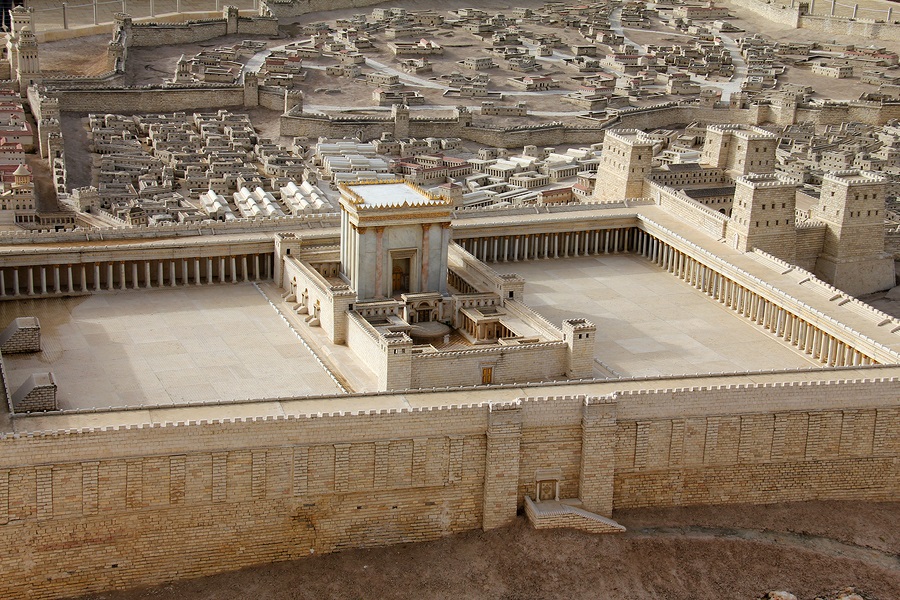
Model of the second temple in ancient Jerusalem. Among the many functions of the temple would have been healing services.

By faith in the name of Jesus, this man whom you see and know was made strong. It is Jesus’ name and the faith that comes through him that has given this complete healing to him, as you can all see. (Act 3:16)
In Acts chapter 3 we have the first recorded miracle of healing done through Jesus’ disciples after Jesus had left the earth to go into heaven. It is truly a remarkable story, and one that we can learn much from here in the 21st Century. This event really launched the post-resurrection ministry of Jesus through his followers that quickly spread throughout the Roman Empire, starting in Jerusalem. Let’s take a close look at this story and see what principles it has for us today in matters of health and healing.
The Place: The great temple in Jerusalem, the center of worship for the Jewish people and the Jewish religion.
The Characters:
1. Peter and John, two of the main leaders of the followers of Jesus who were close friends, and had been with Jesus during his entire earthly ministry from the time he began, until the time he was resurrected from the dead and then ascended to heaven.
2. A crippled beggar, who apparently earned his living each day at the temple begging.
3. The usual crowd of people at the temple, including worshippers, attendants, priests, etc. The number of people would have easily been in the thousands, so that there were many eye-witness accounts of what happened.
The Healing:
One day Peter and John were going up to the temple at the time of prayer—at three in the afternoon.
Now a man crippled from birth was being carried to the temple gate called Beautiful, where he was put every day to beg from those going into the temple courts. When he saw Peter and John about to enter, he asked them for money.
Peter looked straight at him, as did John. Then Peter said, “Look at us!” So the man gave them his attention, expecting to get something from them.
Then Peter said,
“Silver or gold I do not have, but what I have I give you. In the name of Jesus Christ of Nazareth, walk.”
Taking him by the right hand, he helped him up, and instantly the man’s feet and ankles became strong. He jumped to his feet and began to walk. Then he went with them into the temple courts, walking and jumping, and praising God. (Act 3:1-8)
Observations on the healing:
This would not have been the first time that Peter and John had entered the temple. This was a daily event in the early days, after many people had put their faith in Jesus during the Day of Pentecost, as recorded in Acts chapter 2. Three thousand people were added to the fellowship of the apostles of Jesus, and more were being added daily. It appears that many of them met in the temple courts in those early days, in addition to meeting in homes throughout the city.
It is also noted that this was not the first day that the crippled beggar was present. The text states that he was put out there each day. He seems to be well-known among those visiting the temple, and that would have included Peter and John. We can conclude therefore, that Peter and John were not in the habit of walking around the temple each day healing beggars, of which there were surely many at that time. These were mainly disabled people who were allowed to beg right in the temple to earn a living. According to Acts chapter 2, meetings among the new believers were held every day in the temple, primarily for the purpose of teaching about Jesus.
So why did a miracle of healing occur on this particular day? Why was only one man healed among what must have been many? We don’t have the answers to those questions. We must safely conclude that the Holy Spirit of God directed Peter and John on that particular day to perform this miracle of healing. The crippled man did not come to the temple that day expecting to be healed, and Peter and John apparently did not go to the temple with the idea of performing a healing. God directed the whole event — Peter and John just followed directions (see explanation below).
The Reaction:
When all the people saw him walking and praising God, they recognized him as the same man who used to sit begging at the temple gate called Beautiful, and they were filled with wonder and amazement at what had happened to him. While the beggar held on to Peter and John, all the people were astonished and came running to them in the place called Solomon’s Colonnade. (Act 3:9-11)
As can be imagined, seeing this man walking and jumping and praising God caused quite a commotion in the temple! Everyone recognized who this man was, and news apparently spread throughout the temple area quickly. People literally ran to the place where Peter and John and the man were to find out what was going on.
The Explanation:
When Peter saw this, he said to them:
“Men of Israel, why does this surprise you? Why do you stare at us as if by our own power or godliness we had made this man walk? The God of Abraham, Isaac and Jacob, the God of our fathers, has glorified his servant Jesus. You handed him over to be killed, and you disowned him before Pilate, though he had decided to let him go. You disowned the Holy and Righteous One and asked that a murderer be released to you.
You killed the author of life, but God raised him from the dead. We are witnesses of this. By faith in the name of Jesus, this man whom you see and know was made strong. It is Jesus’ name and the faith that comes through him that has given this complete healing to him, as you can all see.” (Act 3:12-16)
Peter makes it very clear that the miracle was not performed by his (or John’s) own power or “godliness.” God performed the miracle, through faith in Jesus.
The events of the life and crucifixion of Jesus would have been fresh in the memories of the people. Jesus had also performed miracles like this one. Peter makes it very clear how the man was healed: “It is Jesus’ name and the faith that comes through him that has given this complete healing to him, as you can all see.“
The faith of Peter and John was the method that God used to perform this miracle. The idea did not originate with Peter and John, nor did the power to heal. God communicated to them that the moment was right to see a miracle happen, and they believed him and acted on their faith.
The Invitation
Now, brothers, I know that you acted in ignorance, as did your leaders. But this is how God fulfilled what he had foretold through all the prophets, saying that his Christ would suffer. Repent, then, and turn to God, so that your sins may be wiped out, that times of refreshing may come from the Lord, and that he may send the Christ, who has been appointed for you–even Jesus. (Act 3:17-20)
Jesus had gained quite a popular following in Jerusalem and around Israel until he was arrested and executed by being nailed to a cross at the direction of the Jewish religious leaders. Many people were undoubtedly discouraged at such a turn of events, having expected that Jesus was the Messiah (Christ) that would setup a new Jewish kingdom in the line and heritage of their great kings of the past, David and Solomon.
But Peter states that they had acted in ignorance in not recognizing that Jesus was in fact the Christ, not understanding that suffering was part of the plan for the Christ. He gives them the invitation to
“Repent, then, and turn to God, so that your sins may be wiped out, that times of refreshing may come from the Lord, and that he may send the Christ, who has been appointed for you—even Jesus.”
Jesus was still alive, because he was resurrected from the dead, and they were witnesses to that fact. Jesus’ death provided a means to have our sins “wiped out” and find new life.
Jesus — The Fulfillment of Prophecy
He must remain in heaven until the time comes for God to restore everything, as he promised long ago through his holy prophets. For Moses said, “The Lord your God will raise up for you a prophet like me from among your own people; you must listen to everything he tells you. Anyone who does not listen to him will be completely cut off from among his people.”
Indeed, all the prophets from Samuel on, as many as have spoken, have foretold these days. And you are heirs of the prophets and of the covenant God made with your fathers. He said to Abraham, “Through your offspring all peoples on earth will be blessed.”
When God raised up his servant, he sent him first to you to bless you by turning each of you from your wicked ways.” (Act 3:21-26)
There were so many pre-conceived ideas about who “the prophet” was according to the writings of Moses, and who the Messiah would be, that many did not accept that Jesus was the Messiah/Christ.
It was known for example, that the Christ would come from the city of David, Bethlehem. Jesus had lived in Galilee from most of his life prior to beginning his ministry, however, and it was not generally known that Jesus was actually born in Bethlehem to fulfill this prophecy.
Isaiah the prophet also foretold the suffering that Jesus would suffer on the cross, and most seemed to not understand that this was part of the prophecy about the Christ, since they were expecting a king to come and setup a physical kingdom.
So much of the teaching of those early days was showing how Jesus fulfilled all of these prophecies. He was indeed the Christ, the Jewish king descended from the line of David, foretold by Moses and all the other prophets in the Old Testament. But instead of being received as their Messiah, he was killed.
The Consequences
The priests and the captain of the temple guard and the Sadducees came up to Peter and John while they were speaking to the people. They were greatly disturbed because the apostles were teaching the people and proclaiming in Jesus the resurrection of the dead. They seized Peter and John, and because it was evening, they put them in jail until the next day. (Act 4:1-3)
So what was the result of healing the crippled beggar and explaining to the people how the healing occurred? They were arrested and spent the night in jail. The religious leaders of the day were divided into two ideological camps: the Pharisees and the Sadducees. Both parties ruled in the Sanhedrin, the Jewish judicial system of that day.
During his ministry on earth, Jesus did not get along too well with either party. There were some secret believers, however, from among the Pharisee group. They were the majority group, and considered the “conservatives” because they held to the traditional teachings of the Old Testament scriptures.
The Sadducees were similar to modern day naturalists, as they did not believe in the resurrection of the body after death. So the teachings of Jesus, and now of his disciples who were claiming that Jesus was raised from the dead, especially upset them. So one can imagine how upset they were at what Peter and John were preaching, saying that they were responsible for executing Jesus who was indeed the fulfillment of prophecy and the Messiah, and that contrary to their teaching, Jesus had in fact been raised from the dead.
The priests were also the ones responsible for administering and providing healing during those days, and Peter and John men were “uneducated,” and had not put in the years of studying that they had.
Because the healing happened in the temple and was witnessed by many people, they could not deny the event. So when they brought Peter and John to trial, they were not quite sure what to do with them:
The next day the rulers, elders and teachers of the law met in Jerusalem. Annas the high priest was there, and so were Caiaphas, John, Alexander and the other men of the high priest’s family. They had Peter and John brought before them and began to question them:
“By what power or what name did you do this?”
Then Peter, filled with the Holy Spirit, said to them:
“Rulers and elders of the people! If we are being called to account today for an act of kindness shown to a cripple and are asked how he was healed, then know this, you and all the people of Israel: It is by the name of Jesus Christ of Nazareth, whom you crucified but whom God raised from the dead, that this man stands before you healed. He is ‘the stone you builders rejected, which has become the capstone.’ Salvation is found in no one else, for there is no other name under heaven given to men by which we must be saved.”
When they saw the courage of Peter and John and realized that they were unschooled, ordinary men, they were astonished and they took note that these men had been with Jesus. But since they could see the man who had been healed standing there with them, there was nothing they could say. So they ordered them to withdraw from the Sanhedrin and then conferred together.
“What are we going to do with these men?” they asked. “Everybody living in Jerusalem knows they have done an outstanding miracle, and we cannot deny it. But to stop this thing from spreading any further among the people, we must warn these men to speak no longer to anyone in this name.”
Then they called them in again and commanded them not to speak or teach at all in the name of Jesus.
But Peter and John replied, “Judge for yourselves whether it is right in God’s sight to obey you rather than God. For we cannot help speaking about what we have seen and heard.”
After further threats they let them go. They could not decide how to punish them, because all the people were praising God for what had happened. For the man who was miraculously healed was over forty years old. (Act 4:5-22)
These religious leaders, the same ones who had Jesus executed, were not happy that a healing was conducted in their jurisdiction, the temple. They were the authority in the land, and something like this should not have happened without their direction and approval. And how could they approve of something that was accredited to someone whom they had executed?
What a quandary! They thought they had gotten rid of the threat to their power by executing Jesus, the leader of this movement, but now the same things were happening with his disciples. Not knowing quite what to do about it, they ordered Peter and John to stop speaking about Jesus.
Principles of the Story
1. The source of healing is Jesus.
Jesus provides the most basic and essential healing everyone needs, and that is spiritual healing from our sins which will result in physical death.
As I have written in previous articles, spiritual healing is of much more value than just physical healing. Our bodies wear out, grow old, and eventually stop functioning and begin decaying. Any physical healing along the way is simply temporary, and does not stop the inevitable physical death. Spiritual health is concerned with not just our physical bodies, but our relationship to our Creator and our eternal destiny as well.
But in this story we see that Jesus was also the cause of temporary physical healing. God decided to heal this man, and communicated this to Peter and John, who believed and acted. God used the faith of Peter and John in this situation.
The naturalistic approach to healing sees only naturalistic cause and effect elements involved in healing, with the knowledge of the healer(s) being seen as responsible for the healing. But no cure, whether medical or natural, can cure 100% of the time, and none of them can prevent ultimate physical death. When God makes a decision to heal, it happens 100% of the time. And Jesus has power over physical death, as he proved by walking out of the grave on the third day.
2. Peter and John were servants, not magicians (doctors)
As was noted above, Peter and John were in the habit of going into the temple each day, but this was the only day we see them heal someone in the temple. If they truly had the power to heal like this any time they wished, you would certainly think they could devote at least a couple of hours a day to seeing patients and healing them, functioning like modern day “doctors.”
But they were not magicians (or “doctors”) who could heal of their own power and own knowledge. They make it very clear that the power and knowledge to heal came through the authority (name) of Jesus, and by faith in Jesus.
Jesus did not leave them with some magical formula to go around and use to heal people whenever they wanted. He left them with his authority to heal, in his name. This is a very important distinction.
Think of it this way: A king sits on his throne ruling over his kingdom. He is the supreme authority. He finds out that someone in a distant part of his kingdom is sick, so he sends two of his servants to that place with the remedy to heal the person. The servants arrive at the place of the patient, apply the cure, and the person is healed. The people living there might marvel and start heaping thanks and praise on the servants that brought the cure. But the servants were simply acting under authority of the king. The king made the decision, the king supplied the remedy, and the king sent his servants to perform the healing. The servants simply obeyed (believed) and acted on the authority of the king.
We see this principle of authority in healing in one of the stories about Jesus healing someone:
When Jesus had entered Capernaum, a centurion came to him, asking for help.
“Lord,” he said, “my servant lies at home paralyzed and in terrible suffering.”
Jesus said to him, “I will go and heal him.”
The centurion replied, “Lord, I do not deserve to have you come under my roof. But just say the word, and my servant will be healed. For I myself am a man under authority, with soldiers under me. I tell this one, ‘Go,’ and he goes; and that one, ‘Come,’ and he comes. I say to my servant, ‘Do this,’ and he does it.”
When Jesus heard this, he was astonished and said to those following him, “I tell you the truth, I have not found anyone in Israel with such great faith…”
Then Jesus said to the centurion, “Go! It will be done just as you believed it would.”
And his servant was healed at that very hour. (Mat 8:5-13)
A magician (or “doctor”), on the other hand, has his own knowledge and acts on his own authority. He creates his own potions (medicines) and cures, and uses his own knowledge to try and affect cures. If the cure works, he takes the credit. But their knowledge is limited, as are their cures.
Throughout the history of mankind if you study the history of the healing arts, you will find that throughout most of this history healers did not just use physical remedies, but sought to manipulate the spiritual world as well in what we could call today “magic.” Even the ancient Greeks, who are the fathers of empiricism, academic study, and modern medicine, appealed to their Greek gods for healing.
In the 5th Century B.C., Hippocrates, considered by many to the be the father of modern medicine, formed a kind of “physicians guild” to uphold a higher standard of ethics in the healing arts, and developed the “The Hippocratic Oath,” still widely referred to today thousands of years later.
Most medical schools today in the 21st Centruy still have some form of the original oath that they require their students to take, but probably all of them have left out the opening of the original: “I swear by Apollo the physician, and Asclepius, and Hygieia and Panacea and all the gods and goddesses as my witnesses, that, according to my ability and judgement, I will keep this Oath and this contract…”
Today, however, we live in the post-Darwin era where academic knowledge is based upon Darwinism, and the spiritual world is largely denied or ignored.
But “magic” is still practiced, as true science has been replaced with “scientism“, which is rooted in the belief in Darwinian evolution, a belief system. Medicine is disguised and promoted as “scientific,” and studies are published in what are considered “peer-reviewed” scientific journals. But fraud is rampant in most of these studies today, with obvious conflicts of interest in wanting to maintain the huge medical system that drives the economy of the world today.
It is interesting to note that the Greek word for our English “medicine” is pharmakeia, from which we get English words such as “pharmacy”, “pharmaceutical,” and “pharmacist.” Outside of the biblical New Testament texts (written in Greek), pharmakeia would probably most often be translated into English as “medicine.” But in the Bible it is translated by words such as “sorcery,” “magic arts,” or “witchcraft.”
If you do a search in the English translations of the Bible for the word “medicine,” the passages containing the Greek word “pharmakeia” will not turn up, even though it is a valid translation. But since the word was associated in lists of evil acts in the Biblical literature, the modern English translators did not consider it appropriate to use “medicine” due to western culture’s positive view of medicine. Instead they used words like “sorcery,” “magic arts,” or “witchcraft.”
See Galatians 5:19-21, for example, and try to guess which English words in that passage are used to translate “pharmakeia.”
3. The consequence of not following the world’s prescribed method of healing is persecution.
Peter and John were simple fishermen by trade, and here they walk into the temple one day and in the name of Jesus heal a crippled beggar. Only the priests were supposed to administer healing and healthcare during those days, after studying and being trained for many years. This action was a direct threat to their authority and control over the people. In this case they only warned Peter and John to stop speaking about Jesus, but in subsequent events they had them whipped and kept them in prison, and even started executing them.
Are things much different today?
I don’t think so. Jesus sits on his throne in heaven and is still the supreme authority in matters of healing. Yes, it is possible to find unauthorized cures. But as I have written in a previous article, trusting in anything or anyone other than our Creator who put us here on earth, and our Savior Jesus who has redeemed us from our sins, amounts to idolatry.
God wants us to trust in him for all of our needs. There are natural cures that can be used in healing, but we are not to put our faith in them, treating them as idols. We are to trust in the Creator and the natural order he created that allows these cures to exist.
The best and most effective cures will be the result of a relationship with our Creator, allowing him to prescribe the healing, and then using the authority of Jesus to enact it. As we develop our relationship with him, it is even possible to see healing occur at times without natural remedies, or where natural remedies fail, simply by using the authority that Jesus gives to us, as happened in this story.
Miracles can still happen today. The only thing that prevents them is our unbelief. Miracles originate from God’s decision and action. We humans cannot create or cause miracles. But we have to believe that miracles still exist, or we will never see one because of our unbelief.
Unfortunately, we still have ruling health authorities in our society who do not acknowledge the authority of Jesus in our culture today, just as Peter and John did in their day. If you don’t follow their rule of authority, you can expect persecution. That persecution can potentially be just as severe as the persecution the early believers suffered, including prison.
But if you follow Jesus’ authority at least you will go to prison healed and with your future destiny secure! Jesus said:
“If anyone would come after me, he must deny himself and take up his cross and follow me. For whoever wants to save his life will lose it, but whoever loses his life for me will find it. What good will it be for a man if he gains the whole world, yet forfeits his soul? Or what can a man give in exchange for his soul?“(Mat 16:24-26)
The path Jesus calls his followers to walk is the same path he walked that ended up with him being executed on the cross. It is a path of persecution, suffering, and shame. The promise and hope for a better life is in the future, not in the present, where any physical healing is temporary, as our bodies continue to age and eventually die, decay, and return to the elements of the earth.
The source of true healing remains the same today as it did back in the days of Peter and John. Don’t put your faith in today’s magicians (doctors) whose cures may or may not give you some temporary relief. Look to Jesus and trust him to provide true healing! Who are you trusting today?
He himself bore our sins in his body on the tree, so that we might die to sins and live for righteousness; by his wounds you have been healed. (1 Peter 2:24)
Who has believed our message and to whom has the arm of the LORD been revealed?
He grew up before him like a tender shoot, and like a root out of dry ground. He had no beauty or majesty to attract us to him, nothing in his appearance that we should desire him.
He was despised and rejected by men, a man of sorrows, and familiar with suffering. Like one from whom men hide their faces he was despised, and we esteemed him not.
Surely he took up our infirmities and carried our sorrows, yet we considered him stricken by God, smitten by him, and afflicted.
But he was pierced for our transgressions, he was crushed for our iniquities; the punishment that brought us peace was upon him, and by his wounds we are healed.
We all, like sheep, have gone astray, each of us has turned to his own way; and the LORD has laid on him the iniquity of us all. He was oppressed and afflicted, yet he did not open his mouth; he was led like a lamb to the slaughter, and as a sheep before her shearers is silent, so he did not open his mouth. By oppression and judgment he was taken away.
And who can speak of his descendants? For he was cut off from the land of the living; for the transgression of my people he was stricken. He was assigned a grave with the wicked, and with the rich in his death, though he had done no violence, nor was any deceit in his mouth.
Yet it was the LORD’s will to crush him and cause him to suffer, and though the LORD makes his life a guilt offering, he will see his offspring and prolong his days, and the will of the LORD will prosper in his hand. After the suffering of his soul, he will see the light of life and be satisfied; by his knowledge my righteous servant will justify many, and he will bear their iniquities.
Therefore I will give him a portion among the great, and he will divide the spoils with the strong, because he poured out his life unto death, and was numbered with the transgressors. For he bore the sin of many, and made intercession for the transgressors. (Isaiah 53:1-12) The Prophecy of Isaiah about Jesus the Christ made hundreds of years before Jesus was born
Related articles:
Medicine: Idolatry in the Twenty First Century
Who is Responsible for Providing Healthcare?
Leave a Reply